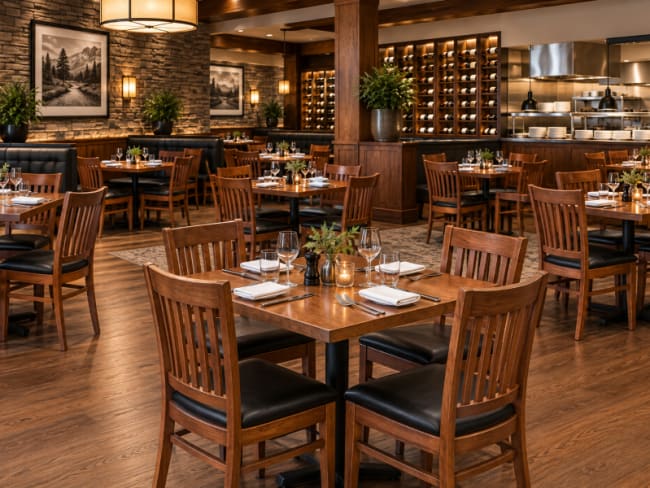
Residential furniture and commercial restaurant furniture may share similar designs, materials, and finishes, but the conditions in which they are used can be considerably different. Furniture in a typical home serves a relatively consistent group of people, while restaurant chairs, tables, and booths accommodate successive guests throughout the day. Frequent movement, repeated cleaning, and continuous use place demands on restaurant furniture that may not be anticipated in products intended primarily for residential settings.
Commercial furniture, often referred to as contract-grade furniture, is designed for specified business and public environments, including restaurants, cafés, bars, and hotels. Its suitability depends on more than appearance or the choice of wood, metal, or upholstery. Frame construction, material performance, applicable testing, environmental conditions, and the ability to maintain consistent furniture specifications across future orders all contribute to evaluating whether a product is appropriate for hospitality use.
The differences between residential and commercial furniture become more apparent when comparing their construction, performance requirements, maintenance expectations, and manufacturer support. Products intended for restaurant use generally incorporate structural reinforcements, specialized surface materials, and documented specifications that are not necessarily required for typical household applications.
The distinction is not simply that commercial furniture is heavier or made from better materials. Contract-grade furniture is intended for specified commercial applications, with product characteristics and documentation that should reflect those conditions. The differences become clearer when comparing how residential and commercial furniture are constructed, evaluated, warranted, and supplied.
|
Characteristic
|
Typical Residential Furniture
|
Commercial Restaurant Furniture
|
|
Intended application
|
Typical Residential Furniture
Household dining and everyday domestic use.
|
Commercial Restaurant Furniture
Repeated use in restaurants and hospitality environments.
|
|
Metal chair frames
|
Typical Residential Furniture
Frequently use separately attached legs or frame components, especially in ready-to-assemble models.
|
Commercial Restaurant Furniture
Commonly use fully welded structural frames with reinforced connections.
|
|
Structural connections
|
Typical Residential Furniture
Assembly hardware and connection methods vary by design.
|
Commercial Restaurant Furniture
Welded joints, reinforced joinery, and structural bracing are common.
|
|
Weight capacity
|
Typical Residential Furniture
Many mass-market dining chairs specify approximately 250 lb.
|
Commercial Restaurant Furniture
A 500 lb published weight capacity is common among commercial restaurant chairs, although ratings vary by model.
|
|
Wood chair construction
|
Typical Residential Furniture
Joinery varies widely across furniture grades.
|
Commercial Restaurant Furniture
Reinforced seat frames, bracing, and substantial structural joints are common.
|
|
Upholstery
|
Typical Residential Furniture
Materials selected for domestic comfort, appearance, and maintenance.
|
Commercial Restaurant Furniture
Coverings and assemblies specified for frequent use, cleaning, and wear.
|
|
Cushion construction
|
Typical Residential Furniture
Varies by comfort preference and price.
|
Commercial Restaurant Furniture
Often specified for support and shape retention under repeated use.
|
|
Table construction
|
Typical Residential Furniture
Commonly sold as complete dining tables.
|
Commercial Restaurant Furniture
Often combines commercial tabletops with separately specified bases.
|
|
Protective finishes
|
Typical Residential Furniture
Selected for normal household exposure.
|
Commercial Restaurant Furniture
Specified for frequent cleaning and anticipated environmental exposure.
|
|
Performance testing
|
Typical Residential Furniture
Residential standards and manufacturer-specific criteria.
|
Commercial Restaurant Furniture
Applicable commercial standards and product-specific performance criteria.
|
|
Warranty coverage
|
Typical Residential Furniture
Commercial use may be excluded.
|
Commercial Restaurant Furniture
Coverage may explicitly include specified commercial applications.
|
|
Repeat ordering
|
Typical Residential Furniture
Availability depends on the retail product line.
|
Commercial Restaurant Furniture
Commercial supply programs can support coordinated orders and replacement specifications.
|
✓
Key Points to Consider
A well-made residential chair may be stronger than a poorly constructed commercial chair, and some materials and manufacturing methods are shared across both categories. What distinguishes contract-grade furniture is its intended application and the specifications supporting that use, not a single visible feature. A product described as commercial-grade should therefore be evaluated through its construction details, relevant performance documentation, care requirements, and warranty terms. These considerations provide a more reliable basis for comparison than appearance, weight, or price alone.
Commercial furniture construction addresses the repeated loading, shifting weight, frequent movement, and sustained use associated with restaurant service. The differences from residential furniture are often found in how structural components are joined, reinforced, and supported. Reinforced wood connections, welded metal frames, commercial upholstery assemblies, and compatible tabletop and base components each address particular sources of wear and stress. These construction details help explain why furniture with a similar appearance can perform differently under comparable operating conditions.
Wood Chair Construction
Reinforced Joinery and Structural Stability
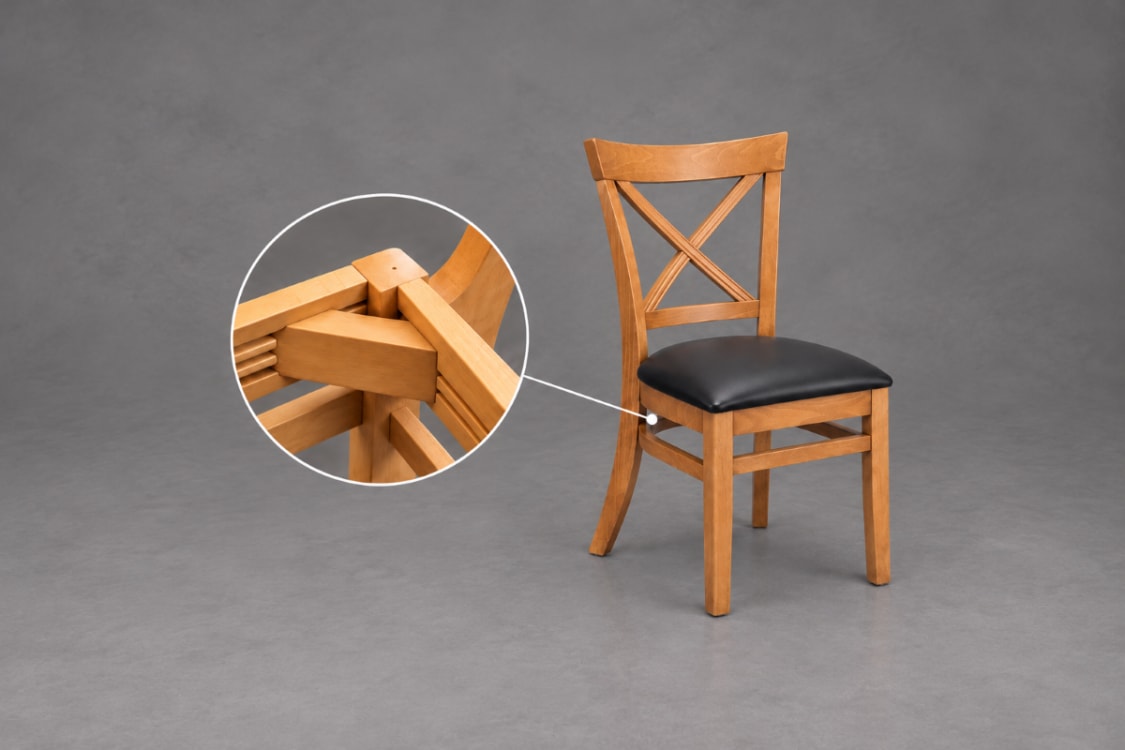
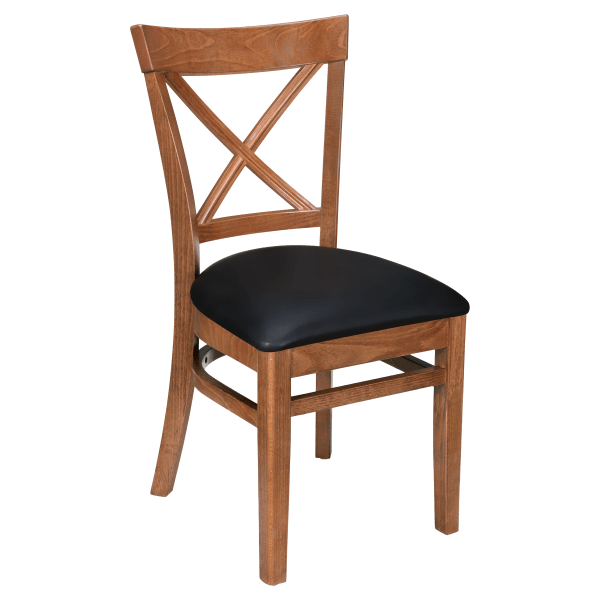
Commercial wood restaurant chairs commonly use mortise-and-tenon joints, dowels, corner blocks, and structural bracing to strengthen connections between the legs, seat frame, and backrest. These components work together to resist movement at the joints, where repeated seating, leaning, and repositioning place stress on the frame. Reinforcement is particularly important because loosening at a single structural connection can affect the stability of the entire chair.
Some residential wood chairs also use traditional joinery, but commercial models place greater emphasis on reinforcing the complete frame for sustained restaurant use. The quality of the connections, their placement, and the way structural members support one another are more significant than wood species alone. Commercial durability begins with a frame designed to remain stable under repeated loading rather than relying solely on the strength of its individual components.
Metal Chair Construction
Fully Welded Frames and Load Distribution
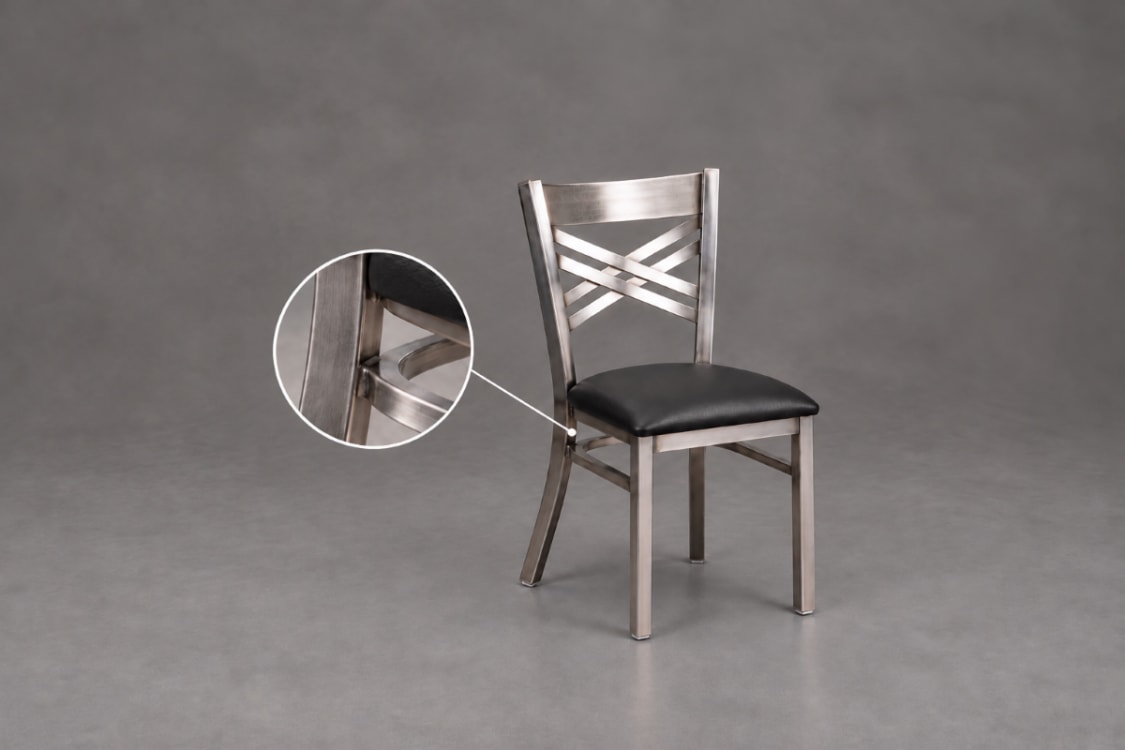
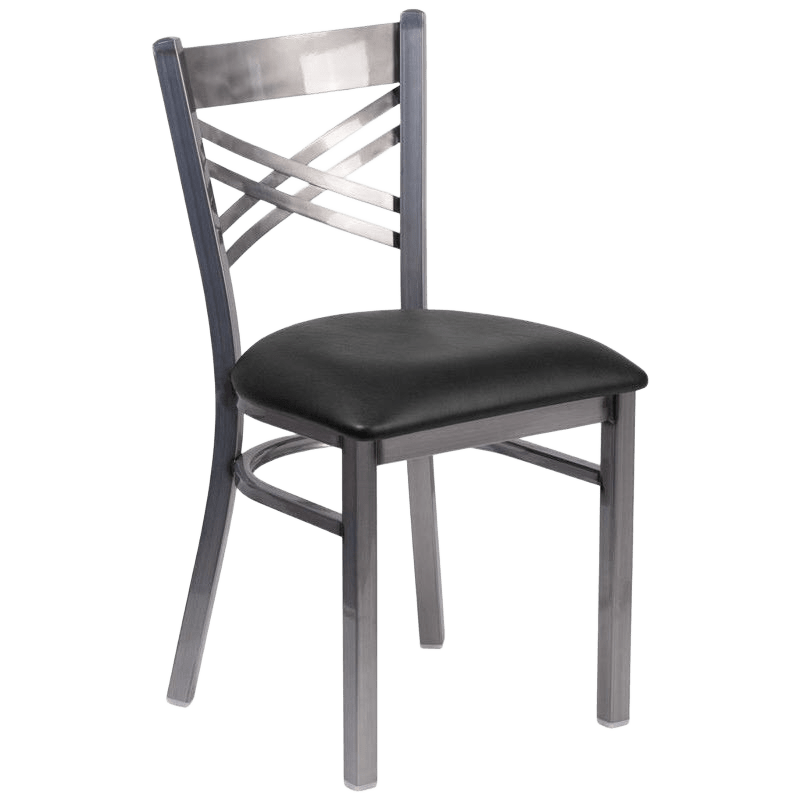
A defining characteristic of many commercial metal restaurant chairs is a fully welded structural frame. The legs, seat supports, back supports, and reinforcing members form a connected assembly that transfers weight through the frame to the floor. When a guest leans backward, shifts sideways, or moves the chair, additional forces concentrate around structural connections. Welded joints and strategically positioned reinforcement help distribute those forces and reduce movement between frame components.
This construction differs from many ready-to-assemble residential metal dining chairs, where legs or other primary structural members are attached using bolts and assembly hardware. Attaching a seat to a completed welded frame is not equivalent to assembling the load-bearing frame itself. Commercial metal chairs commonly combine welded construction with reinforced stress points, and many restaurant models carry a published weight capacity of 500 lb. The structural design and integrity of the frame connections matter more than metal thickness alone.
Upholstery and Cushioning
Materials, Padding, and Seat Support
Commercial upholstery is specified for conditions that differ from typical household seating. Restaurant chairs and booths experience repeated contact, friction, spills, and cleaning throughout service, placing particular importance on covering materials, seam construction, and upholstery attachment. Commercial vinyls and contract fabrics are selected according to relevant wear characteristics and maintenance requirements, while reinforced stitching and secure upholstery connections help the covering withstand repeated use.
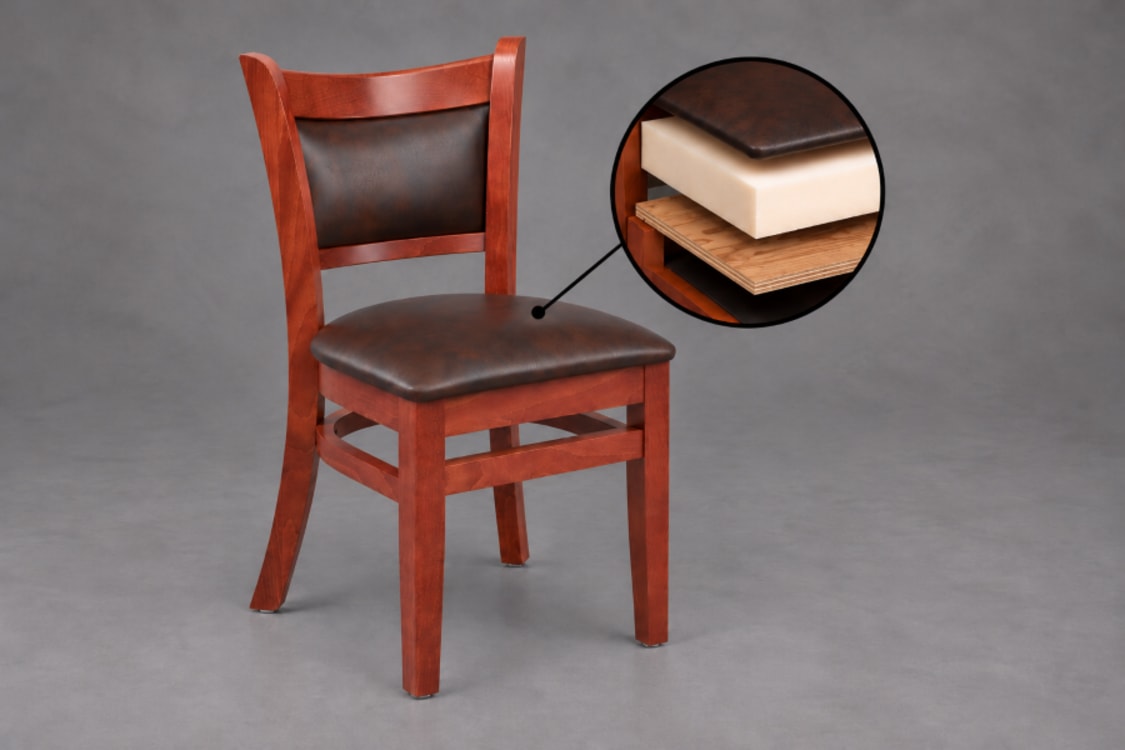
Cushion construction is equally important. Commercial seating commonly uses supportive foam and underlying seat structures selected to retain their shape and function under repeated loading. Foam density, firmness, and resilience describe different properties, and the highest value in any one category does not automatically produce the best result. Unlike upholstery chosen primarily for domestic comfort and appearance, a commercial seating assembly must balance comfort with the performance of its covering, cushioning, seams, and supporting structure.
Restaurant Table Construction
Commercial Tabletops, Base Attachments, and Structural Support
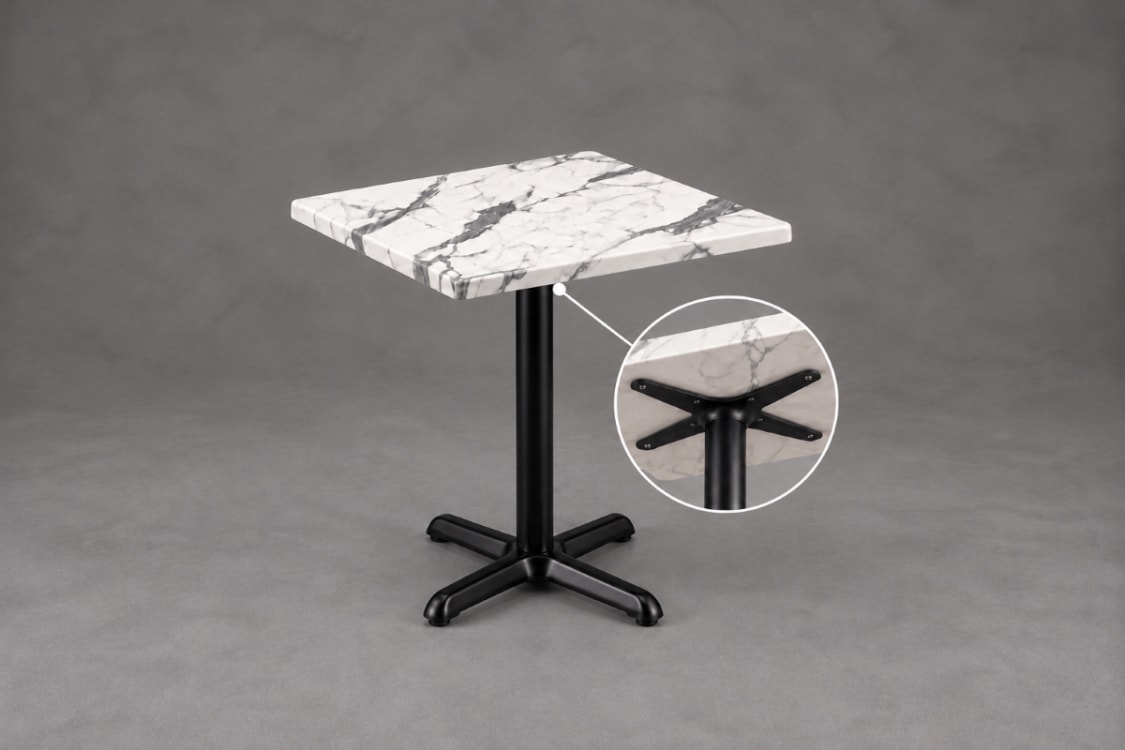
Commercial restaurant tables are commonly assembled from tabletops and bases specified as compatible components. This approach allows restaurants to select surface materials, dimensions, and supporting bases for their installation while facilitating replacement of individual components. Residential dining tables, by comparison, are often sold as complete furniture pieces with integrated or separately attached legs. The distinction is not simply whether a table requires assembly, but how its surface, mounting system, and supporting structure are specified for the intended application.
Commercial tabletops frequently use protective laminates, finished solid wood, or other surfaces selected for repeated cleaning and contact. Edge construction and substrate protection are particularly important where spills and impacts can expose vulnerable materials. Beneath the surface, mounting hardware and base geometry must provide adequate support for the tabletop's dimensions and weight. A stable commercial table depends on the compatibility of the entire assembly, not the apparent strength of the top or base alone.
Finishes and Protective Coatings
Commercial furniture finishes are selected with the cleaning practices and environmental conditions of hospitality use in mind. Protective wood coatings, powder-coated metal, and commercial laminate surfaces help resist specific forms of wear, moisture exposure, and contact with cleaning products. Some residential furniture can use the same finishing technologies, but commercial specifications place greater emphasis on durability under heavy daily use and compatibility with the anticipated maintenance routine. Finish performance depends on the underlying material, surface preparation, application quality, and approved cleaning procedures.
✓
Key Points to Consider
The distinction between residential and commercial construction is ultimately found in how the furniture is engineered as a complete product. Reinforced connections, welded structural frames, upholstery assemblies, and compatible table components are intended to address the stresses of restaurant service. The next consideration is how manufacturers evaluate these characteristics through performance testing and documented specifications.
Commercial furniture is distinguished not only by how it is constructed, but also by how its performance is evaluated. Structural strength, resistance to repeated loading, stability, upholstery wear, and fire safety can all be assessed through defined testing procedures. These evaluations provide a more reliable basis for comparing furniture than appearance, material descriptions, or an unsupported commercial-grade label.
Not all furniture tests serve the same purpose. Some establish performance expectations for commercial use, while others address specific material properties or legally required safety conditions. Understanding the organizations, standards, and test methods involved helps clarify what a manufacturer's specifications actually demonstrate.
1
Commercial Performance Standards
BIFMA
The Business and Institutional Furniture Manufacturers Association
(BIFMA) develops performance standards for furniture used in business,
institutional, and public environments. Its standards establish
procedures for evaluating structural strength, durability, and
stability under defined testing conditions.
For restaurant seating, the
ANSI/BIFMA X5.4 Public and Lounge Seating Standard
is particularly relevant because its scope includes restaurant,
dining, and cafeteria chairs. The current reaffirmed designation
is ANSI/BIFMA X5.4-2020 (R2025).
-
BIFMA develops standards; it does not automatically certify
every furniture product described as commercial-grade.
-
Different furniture categories are covered by different standards.
-
A claim of compliance should identify the applicable standard
and the product evaluated.
2
Standards Development and Approval
ANSI
The
American National Standards Institute (ANSI)
coordinates and oversees the U.S. voluntary consensus standards
system. ANSI accreditation and approval processes help ensure
that standards are developed according to established
procedural requirements.
The designation ANSI/BIFMA indicates an American National
Standard developed through BIFMA's standards process.
It does not mean ANSI personally tests furniture or
guarantees the performance of an individual chair.
-
ANSI approves standards developed through accredited processes.
-
ANSI/BIFMA is a standards designation, not a universal
product certification.
-
The applicable standard and edition should be identified
when evaluating a compliance claim.
3
Structural Strength Evaluation
Static Load Testing
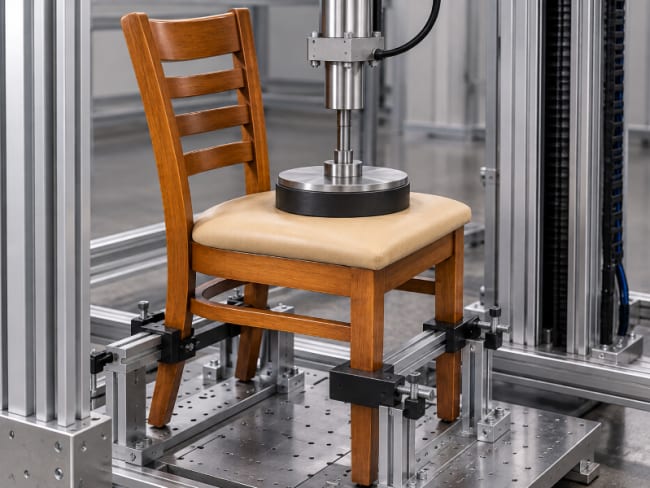
Static load testing applies a specified force or weight to
furniture under controlled conditions. Depending on the
procedure, the load may be applied to the seat, backrest,
arms, or other structural components to evaluate their response.
For commercial seating, static load evaluations help identify
whether the frame and its connections can withstand prescribed
forces without unacceptable damage or loss of function.
These tests complement repeated-load durability evaluations,
which examine how furniture responds to cyclic stresses.
-
Test procedures define where, how, and for how long
a load is applied.
-
Seat and backrest tests examine different structural demands.
-
A published user weight capacity is not necessarily
the same as a laboratory test load.
4
Upholstery Abrasion Testing
Wyzenbeek
The Wyzenbeek method evaluates
the abrasion resistance of textile fabrics by repeatedly
rubbing a test specimen under controlled conditions.
Results are commonly expressed as double rubs,
representing back-and-forth abrasion cycles.
Wyzenbeek results help compare upholstery materials,
but they do not directly predict how many years a chair
or booth will last. The
Association for Contract Textiles Abrasion Testing Disclaimer
explains why abrasion ratings should not be treated as
direct predictions of service life. Actual performance
also depends on fiber or coating properties, seam
construction, cleaning practices, and conditions of use.
-
Double-rub results describe performance under
a specific laboratory method.
-
Higher ratings do not necessarily translate into
proportionally longer service life.
-
Abrasion resistance is only one characteristic
of a complete upholstery system.
5
Upholstered Furniture Fire Safety
California TB 117-2013
California Technical Bulletin 117-2013 establishes
smolder-resistance requirements for specified upholstered
furniture materials and assemblies. Its testing approach
addresses ignition from a smoldering source rather than
evaluating general resistance to open flames.
The requirements of TB 117-2013 are incorporated into
the mandatory federal upholstered-furniture flammability
standard, 16 CFR Part 1640, for products within its scope.
Covered upholstered restaurant seating is therefore
subject to applicable federal requirements, not merely
a voluntary California guideline. The
CPSC Upholstered Furniture Flammability Requirements
explain the standard's scope, testing, and labeling obligations.
-
The standard addresses smoldering ignition conditions.
-
Federal applicability depends on whether the product
meets the regulation's definition of covered
upholstered furniture.
-
Compliance includes applicable labeling and
certification obligations.
6
Upholstery Ignition Resistance
NFPA 260
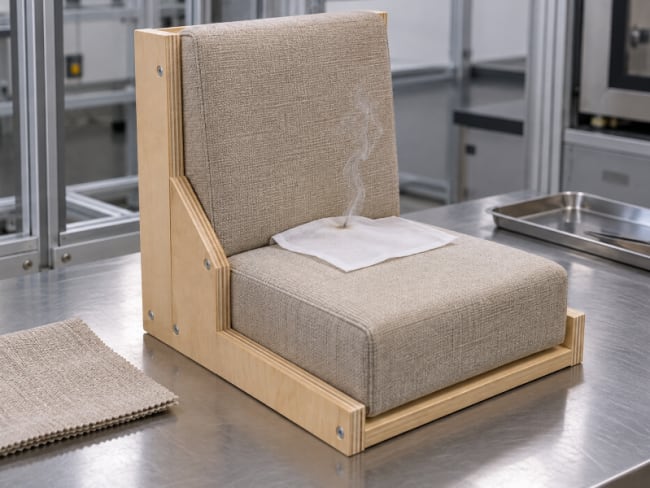
NFPA 260 is a standard test method developed by the
National Fire Protection Association
for evaluating the resistance of upholstered furniture
components to cigarette ignition. It examines specified
material combinations under controlled smoldering conditions.
NFPA 260 is relevant when referenced by applicable fire
codes, project specifications, or purchasing requirements.
It should not be confused with a universal nationwide
requirement for restaurant furniture or with an
open-flame test.
-
Evaluates cigarette-ignition resistance under
specified conditions.
-
Can be referenced by adopted fire codes or
project requirements.
-
Addresses a different question from structural
durability or upholstery abrasion.
What Commercial Furniture Tests Actually Evaluate
The terminology above covers organizations, standards, and individual test methods, but the practical purpose of testing is to evaluate particular aspects of furniture performance. A restaurant chair can perform well in one category without necessarily meeting the requirements of another. Structural strength, stability, upholstery abrasion, and flammability must therefore be considered as separate characteristics.
|
Evaluation
|
What It Examines
|
Why It Matters
|
|
Structural strength
|
What It Examines
Response to specified loads applied to seats, backs, or supporting components.
|
Why It Matters
Evaluates frame and connection strength.
|
|
Repeated-load durability
|
What It Examines
Response to repeated loading or movement cycles.
|
Why It Matters
Examines resistance to cumulative structural stress.
|
|
Stability
|
What It Examines
Resistance to tipping under defined conditions.
|
Why It Matters
Evaluates balance and support.
|
|
Upholstery abrasion
|
What It Examines
Surface wear during controlled rubbing cycles.
|
Why It Matters
Helps compare covering materials.
|
|
Flammability
|
What It Examines
Response to specified ignition conditions.
|
Why It Matters
Addresses applicable fire-safety requirements.
|
|
Finish resistance
|
What It Examines
Response to specified substances, abrasion, or environmental exposure.
|
Why It Matters
Helps assess surface suitability and maintenance.
|
The distinction between structural strength and durability is particularly important. A chair that withstands a substantial load once has not necessarily demonstrated how its joints and supporting frame will perform after repeated loading. Commercial seating standards address multiple aspects of performance because restaurant furniture experiences a combination of forces over time.
Fire Safety: Mandatory Requirements and Voluntary Standards
Fire safety introduces an important distinction between performance testing and regulatory compliance. Commercial seating can be evaluated against voluntary structural standards, but covered upholstered furniture must also satisfy applicable legal flammability requirements. These obligations are not exclusive to restaurants: the federal upholstered-furniture rule applies to qualifying products intended for residential and commercial settings alike.
The distinction is easier to understand when separating industry performance standards from enforceable safety requirements.
Voluntary Performance Standards
Standards such as ANSI/BIFMA X5.4 establish controlled evaluations of structural strength, durability, and stability for applicable public seating. Manufacturers use these standards to substantiate specific performance claims and document how furniture performs under defined commercial seating tests. They are generally voluntary unless required by an applicable rule or purchasing agreement.
Mandatory Safety Requirements
Federal law requires covered upholstered furniture to meet the smolder-resistance requirements incorporated from TB 117-2013 under 16 CFR Part 1640. Compliance also involves prescribed product labeling. The regulation applies to covered upholstered furniture regardless of whether it is intended for residential or commercial use. Other applicable requirements must be assessed according to the product, installation, and jurisdiction.
How Upholstered Furniture Requirements Are Enforced
In the United States, the Consumer Product Safety Commission administers the federal upholstered-furniture flammability requirements under CFR Part 1640. Covered furniture manufactured, imported, or reupholstered for sale must meet the applicable TB 117-2013 requirements. The regulation also requires a permanent certification statement on covered products. These requirements took effect in stages beginning in 2021, with the labeling requirement applying from June 2022.
The regulation evaluates the smolder resistance of specified upholstery components and material combinations. It does not establish a chair's structural strength, commercial weight capacity, or expected service life. Federal law also contains preemption provisions concerning certain state and local upholstered-furniture flammability requirements, so additional fire-code provisions must be evaluated for their applicability rather than assumed to apply to every restaurant. NFPA 260 remains relevant where a valid project specification or applicable code calls for that method.
Understanding Test Results and Weight Ratings
Published weight capacities should be considered alongside the manufacturer's supporting performance documentation. A chair advertised with a 500 lb capacity, for example, should be evaluated according to the testing procedures used, the structural components examined, and the conditions under which the results were obtained. These details help establish what the rating demonstrates and whether additional performance information is needed for the intended application.
The distinction matters because static loading, repeated loading, and stability testing evaluate different aspects of performance. A chair may withstand a prescribed downward force but still require separate evaluation of backrest strength, connection durability, or tipping resistance. Meaningful documentation identifies the product tested, the standard or procedure followed, and the result obtained.
Upholstery ratings require similar care. As explained in the Association for Contract Textiles' abrasion testing disclaimer, double-rub counts should not be treated as a direct prediction of service life. Cleaning compatibility, seam integrity, coating performance, and cushion construction remain important even when a covering material has a high abrasion rating.
✓
Key Points to Consider
Commercial-grade is a description of intended use, not a universal certification. A credible performance claim should be supported by relevant, product-specific specifications, applicable test results, and required safety documentation. Understanding what was tested, and what the result actually establishes, provides a stronger basis for distinguishing commercial furniture from residential alternatives than an advertised weight capacity or durability claim alone.
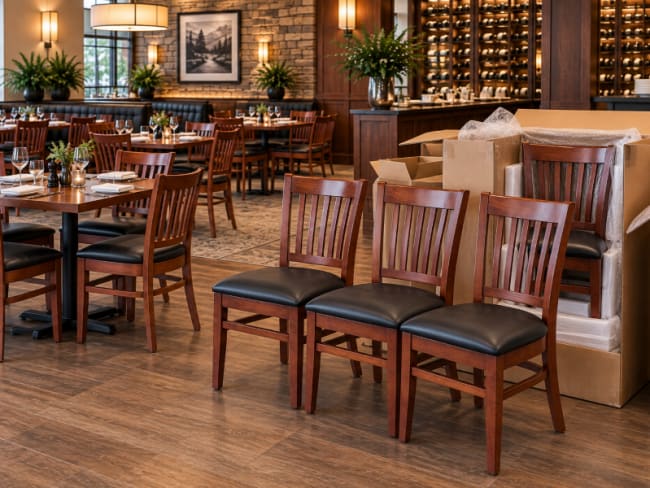
Commercial furniture differs from residential furniture in more than construction and performance requirements. It is also supplied through purchasing and production programs that can accommodate large installations, coordinated specifications, replacement orders, and future expansion. While residential furniture is commonly purchased as individual pieces or matching sets, hospitality projects may require hundreds of coordinated furniture items delivered according to a defined set of specifications.
This distinction becomes increasingly important as restaurants grow and evolve. A furniture selection made for an initial opening may need to be repeated during renovations, seating expansions, or the development of additional locations. Commercial furniture suppliers can support these requirements through standardized product configurations, documented finishes, coordinated manufacturing, and project-based ordering.
Consistency Across Large Installations
Large hospitality installations frequently require substantial quantities of chairs, bar stools, booths, and tables that must maintain consistent dimensions, finishes, and construction details. A single project may involve hundreds of furniture pieces, sometimes across several seating configurations and upholstery selections.
Commercial furniture programs support coordinated production and ordering, helping maintain consistency throughout an installation. Unlike purchasing individual residential pieces from changing retail inventories, project-based procurement allows specifications to be established before quantities are manufactured or supplied.
Replacement and Reordering
Restaurant furniture is replaced, repaired, and supplemented throughout its service life. Individual chairs may become damaged, upholstery may require replacement, or an existing dining area may need additional seating. Matching the original furniture becomes difficult when models are discontinued or finishes and materials change.
Commercial suppliers with established product programs can support repeat orders, replacement components, and matching specifications. Residential collections, particularly those associated with seasonal retail assortments, may offer less continuity after their initial sales period. Availability still depends on the manufacturer and product line.
Franchise Growth and Multi-Location Consistency
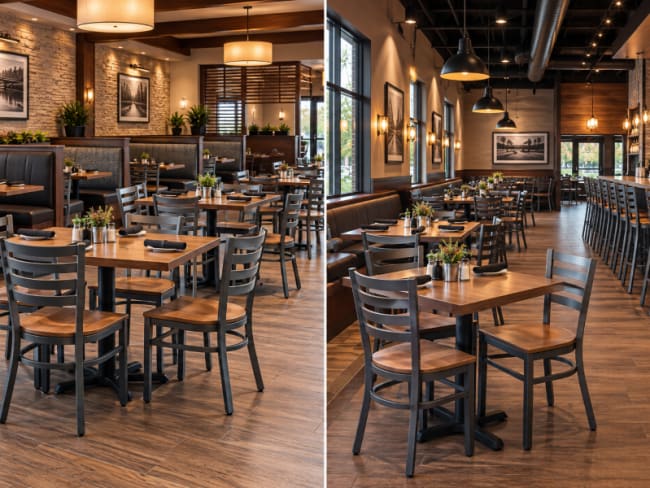
Restaurant chains and expanding hospitality concepts often establish furniture specifications that can be repeated across multiple locations. Standardized chair models, upholstery selections, table configurations, and finishes help maintain a recognizable environment while simplifying purchasing for new installations.
Commercial furniture programs can support this process through documented product specifications, coordinated orders, and repeatable configurations. Rather than selecting furniture independently for each location from available retail collections, expanding operators can work from an established specification that supports a consistent brand identity.
Specification Control and Procurement Continuity
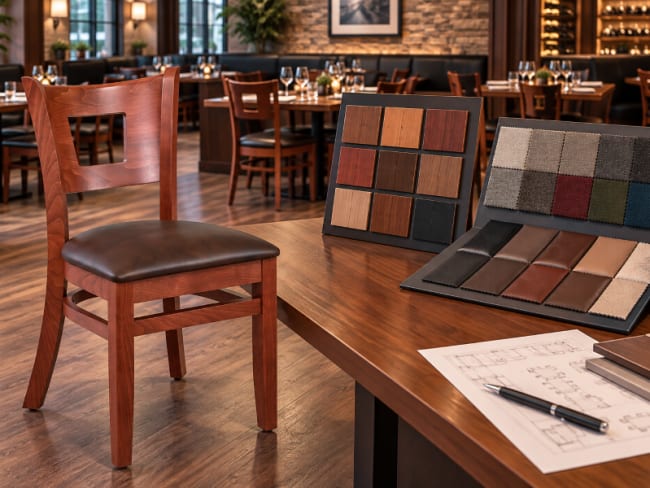
Long-term consistency depends on more than a product remaining in a catalog. Commercial furniture programs can document frame finishes, upholstery materials, dimensions, tabletop configurations, and other product details so that future orders can be compared against the original specification.
Customization can also become part of this process when a project requires particular finishes or upholstery combinations. However, repeat production depends on material availability, manufacturing arrangements, minimum order quantities, and lead times. A documented specification provides a reference for future purchasing, but does not guarantee that every material or product will remain available indefinitely.
✓
Key Points to Consider
What Long-Term Consistency Requires
Maintaining a coordinated furniture program over several years requires reliable product documentation and an understanding of manufacturing limitations. Even when the same model remains available, natural wood variation, changes in finish batches, and upholstery dye lots can produce visible differences between orders.
Detailed records of model numbers, dimensions, frame finishes, upholstery identifiers, and tabletop materials provide a reliable reference for replacement and expansion orders. Established commercial suppliers can also help coordinate matching specifications and purchasing requirements for future orders.
Commercial furniture pricing reflects more than the visible materials in a finished chair, table, or booth. Structural construction, upholstery specifications, protective finishes, manufacturing requirements, and applicable performance testing can influence production costs. Project quantities, custom configurations, and freight arrangements also affect the final purchase price.
Price alone, however, does not establish whether furniture is suitable for restaurant use. A premium residential dining chair may cost considerably more than a commercial restaurant chair, while two visually similar commercial products may differ in construction, testing, and warranty coverage. Meaningful comparisons require an understanding of what is included in the product specification and what the purchase price actually represents.
Why Commercial Furniture Often Costs More
Compared with mass-market residential furniture, contract-grade products often involve additional manufacturing requirements associated with repeated commercial use. Fully welded metal frames, reinforced wood connections, commercial upholstery materials, and protective surface treatments can increase production costs depending on the product. Documented performance testing, specialized components, and additional quality-control procedures may also contribute to pricing. These characteristics help explain why furniture with similar dimensions and appearances can carry substantially different prices.
Commercial orders also introduce purchasing variables that affect the final cost. Custom upholstery, specified finishes, production quantities, packaging, shipping methods, and delivery requirements can change the price of an otherwise standard product. Larger orders may benefit from volume pricing, but customization, specialized freight, or installation requirements can offset those savings. As a result, the relevant comparison is between products with equivalent specifications and purchasing conditions, rather than simply between their advertised prices.
Initial Price vs. Long-Term Ownership Cost
The purchase price represents only one part of the financial commitment associated with restaurant furniture. Maintenance, cleaning, repairs, replacement components, and eventual replacement can contribute to the total cost of ownership. A lower purchase price can be offset by repair or replacement costs, while a higher price offers little advantage if the furniture is unsuitable for its intended application.
Repairability and warranty coverage also affect long-term value. Replaceable seats, accessible hardware, and available components can make certain repairs more practical than replacing an entire furniture piece. Commercial warranties should be examined for their stated coverage, duration, exclusions, and claim procedures. Residential furniture warranties frequently restrict or exclude business use, making the manufacturer's intended-use designation especially important when comparing products for restaurant applications.
These considerations make product documentation as important as initial pricing. The following checklist identifies the information needed to evaluate commercial furniture beyond its appearance or advertised durability.
1
Intended Use
Confirm the Intended Commercial Application
A commercial-grade description should identify the environments
for which a product is designed. Restaurant dining rooms, bars,
covered patios, and exposed outdoor areas have different
requirements. Furniture specified for one setting is not
automatically suitable for another.
-
Confirm that the manufacturer designates the product
for commercial use.
-
Check whether indoor, outdoor, or other environmental
restrictions apply.
-
Identify any limitations affecting the proposed installation.
2
Product Compatibility
Verify Dimensions and Configuration
Furniture must fit its intended installation and work with
surrounding components. Published dimensions, seat heights,
tabletop sizes, and base compatibility provide more reliable
information than photographs or general product descriptions.
-
Verify overall dimensions and relevant seating measurements.
-
Confirm tabletop and base compatibility when components
are purchased separately.
-
Check configuration details affecting installation
or replacement.
3
Structural Specifications
Examine Construction and Materials
Commercial furniture should be evaluated through its frame
construction, structural connections, upholstery assembly,
and surface materials. Broad descriptions such as
"heavy-duty" or "premium quality" are less informative
than identifiable construction features.
-
Review frame materials, joinery, welding,
and reinforcement details.
-
Identify upholstery coverings, cushioning,
and support construction where applicable.
-
Examine tabletop substrates, edge construction,
and protective finishes.
4
Verified Performance
Review Testing and Performance Documentation
Published weight capacities and durability claims are more
meaningful when supported by identifiable test methods
or performance standards. Documentation should establish
what was evaluated rather than relying on a general
"contract-grade" description. For additional context,
see
Understanding Commercial Furniture Testing.
-
Identify applicable ANSI/BIFMA standards or other
relevant test methods.
-
Distinguish published user weight capacities
from laboratory test loads.
-
Confirm required flammability compliance for
covered upholstered furniture.
5
Care and Maintenance
Confirm Cleaning and Maintenance Requirements
Furniture finishes and upholstery materials respond
differently to cleaning agents, moisture, and repeated
maintenance. Compatibility with the restaurant's cleaning
procedures is important to long-term suitability.
-
Obtain the manufacturer's recommended cleaning instructions.
-
Check restrictions on disinfectants, solvents,
abrasives, and moisture exposure.
-
Identify maintenance procedures needed to preserve
the finish or upholstery.
6
Warranty Protection
Examine Commercial Warranty Coverage
Warranty terms should explicitly address the proposed
commercial application. Coverage can differ between
structural frames, upholstery, finishes, and other
components. The stated warranty period may not
apply equally to every part.
-
Confirm that commercial or restaurant use is covered.
-
Review component-specific coverage, exclusions,
and claim requirements.
-
Determine whether labor, shipping, and replacement
parts are included.
7
Supplier Information
Request Complete Product Documentation
Reliable specifications establish exactly what is being
purchased. They also provide a reference for questions
about dimensions, materials, maintenance, or warranty
coverage after installation.
-
Obtain current product specifications and
care documentation.
-
Record model numbers, finishes, upholstery identifiers,
and configuration details.
-
Confirm important specifications in writing
when product descriptions are incomplete.
8
Replacement and Continuity
Establish Future Ordering Options
Restaurants may need additional furniture or replacement
components after the initial purchase. Future availability
cannot be guaranteed, but understanding the supplier's
ordering and support arrangements helps identify potential
limitations before committing to a furniture program.
-
Ask about replacement seats, components,
and upholstery options.
-
Confirm lead times, minimum quantities,
and customization requirements.
-
Establish how future orders and specification
changes are handled.
✓
Key Points to Consider
Evaluating Furniture Beyond Appearance
A complete evaluation combines physical characteristics with documented product information. Examining furniture in person can help assess comfort, finish quality, and visible workmanship, but appearance alone cannot establish structural performance, regulatory compliance, or warranty suitability. Whether purchased through a showroom, distributor, or online supplier, commercial furniture is best assessed through clear specifications, relevant testing information, appropriate warranty coverage, and a demonstrated fit for its intended application.
Selecting restaurant furniture requires evaluating construction quality, documented performance, maintenance requirements, warranty coverage, and long-term purchasing considerations together. No single feature establishes whether a product is appropriate for commercial use. Its suitability depends on how well the complete furniture assembly meets the demands of the intended environment and the support available throughout its service life.
Just as important as the furniture itself is the reputation and experience of the supplier behind it. Established hospitality furniture suppliers bring industry knowledge, specification transparency, manufacturing relationships, and an understanding of the operational demands restaurants face over time. Unlike short-cycle retail programs focused primarily on individual purchases, dedicated commercial furniture suppliers can provide the coordinated ordering, customization, replacement support, and procurement continuity that larger hospitality projects often require. Choosing a reputable supplier therefore becomes an important part of supporting the initial investment and maintaining consistency as a restaurant's furniture needs evolve.
At Affordable Seating, that commitment extends beyond the initial furniture order. Our experience serving the hospitality industry informs how we approach product selection, customization, coordinated installations, and the evolving needs of restaurant operators. From independent restaurant openings to multi-location expansion, we work to provide commercial furniture and purchasing support that help businesses maintain the durability, visual consistency, and operational functionality their environments demand.